
At Wood Lane Nature Reserve we have a constant battle against an introduced water plant. The New Zealand Pygmyweed is, as the name suggests, a water plant that's normally found in New Zealand or Australia but was brought into the UK as an ornamental pond plant. By the 1950's it had escaped into the wild and began to infest waterways around the country.
New Zealand Pygmyweed & Wood Lane

Wood Lane Nature Reserve faces an ongoing challenge with New Zealand Pygmyweed, an introduced aquatic plant that forms dense mats and disrupts habitats for wading birds. After spreading aggressively during the COVID pandemic, the weed covered key mudflat feeding areas...

New Zealand Pygmyweed
(c) GB Non Native Invasive Species Secretariat
The problem with the plant is that it grows as a dense mat, smothering out other plants. It's also tough, refusing to die back in our winter climate, and can grow from a tiny piece. This makes it extremely difficult to eradicate, and usually our best hope is to control it the best we can.
Wood Lane is divided into multiple pools, separated by bunds. The bunds allow us to control the water levels, as well as providing habitat for birds that nest on the margins. They also help prevent the spread of the Pygmyweed into the other pools.
Lapwing Hide faces out over the largest of the pools, and the majority of the pool is very shallow. This is ideal for wading birds who seek out food in the mud flat. However, unfortunately, this is also the worst affected area by the New Zealand Pygmyweed.
The mud flat is sufficiently wet that the weed can spread across it, and once it's there, it thickens and adds layer after layer. During the Covid epidemic the weed got a much stronger foothold which makes management more difficult.
This year we found that it had established a mat up to thirty centimeters deep. The entire flat had no exposed mud, and it was impossible for the wading birds to feed there.
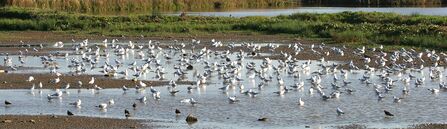
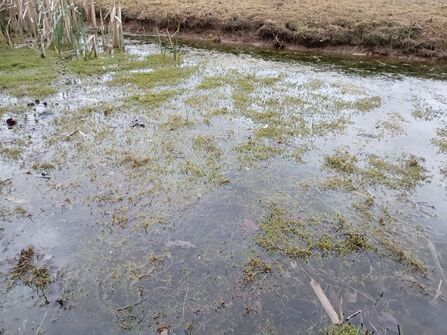
We have to keep removing it to maintain the mudflat, so the waders can keep feeding. It is impossible to remove all traces of the Pygmyweed, so it will continue to return and challenge us.